


MFA for RDP: Stop Unauthorized Remote Desktop Access Cold
Remote Desktop Protocol (RDP) remains one of the most exploited remote access protocols in enterprise environments. Attackers continuously scan for exposed port 3389, use stolen credentials, and attempt lateral movement through RDP sessions. A password alone is no longer sufficient.
Protectimus provides a targeted MFA solution specifically for Remote Desktop. The Protectimus Winlogon component intercepts authentication at the Windows Credential Provider level, adding a strong second factor directly into the RDP login flow — without changing the existing remote access architecture.
Table of Contents
- Why RDP Is the #1 Attack Vector in Enterprise Networks
- How Protectimus MFA Works with Remote Desktop Protocol
- Supported Authentication Methods for RDP
- RDP MFA Deployment Scenarios
- System Requirements & Compatibility
- Step-by-Step: How to Add MFA to RDP in 4 Steps
- Advanced Configuration Options
- Compliance & Security Standards
- Customer Stories & Use Cases
- Frequently Asked Questions
- Get Started with RDP MFA Today
Quick Answer
Deploy the Protectimus Winlogon Agent on your RDP servers, connect it to either the Protectimus cloud service or on-premises platform, and enforce MFA for RDP sessions. Most organizations complete a single server setup in under 2 hours.
Key facts
Stolen credentials fuel ransomware
73% of ransomware victims had a credential leak or infostealer infection in the year prior to the attack
RDP: ransomware's favorite entry point
Over 90% of ransomware incidents involve RDP as the initial access vector
CISA Alert AA22-074A
CISA calls out RDP as a primary attack vector and recommends MFA as the top mitigation
Key Takeaways

No VPN dependency
MFA challenge occurs at the Windows Credential Provider level, before the session opens.

Emergency access
One-time backup codes provide a secure recovery option when normal MFA validation cannot be performed.

Full NLA-compatibility
Works with Network Level Authentication enabled — the recommended security baseline for all RDP deployments.

Broad Service Coverage
Protects AD, VPN gateways, ADFS-federated apps, Windows logon and RDP, OWA, and custom web applications.

Scalable deployment
The Protectimus Winlogon component supports centralized deployment via GPO, simplifying rollout across large Windows environments.
Why RDP Is the #1 Attack Vector in Enterprise Networks
In the early days of the pandemic, organizations scrambled to expose RDP to the internet. Many never locked it back down. Today, security scanners consistently find millions of hosts with port 3389 reachable from the public internet — and attackers know exactly where to look.
The threat model against RDP-exposed systems breaks into three categories, each of which a password alone cannot stop:
Credential stuffing and brute force. Attackers cycle through credential lists from previous breaches — billions of username/password pairs traded on dark web forums and Telegram channels. A strong password offers no protection if it was reused from a breached site. Tools like Hydra and Medusa attempt thousands of RDP login combinations per minute against unthrottled endpoints.
Pass-the-hash and Kerberoasting. Once an attacker has a foothold on any Windows machine in your environment — through phishing, a vulnerable web app, anything — they can harvest NTLM hashes from memory using Mimikatz and authenticate to other Windows systems via RDP without ever knowing the plaintext password. A time-based OTP (TOTP) generated fresh every 30 seconds is not stored anywhere that pass-the-hash can reach.
RDP vulnerabilities. CVE-2019-0708 (BlueKeep) and CVE-2019-1181/1182 (DejaBlue) demonstrated that RDP itself can contain pre-authentication memory corruption vulnerabilities. Patching remains the primary control, but defense in depth requires a second authentication layer even on fully patched servers.
IP allowlisting is not a substitute for MFA. Firewall rules allowing only known corporate IPs fail in four common situations: employees on dynamic home ISPs; business travel; third-party vendor access; and — most critically — any attacker who has already compromised a machine inside the allowed range. An internal attacker moving laterally via RDP hits the same allowlist your admin uses.
NIST SP 800-63B is explicit on this point: any RDP endpoint accessible from more than a single trusted physical location should require MFA.
How Protectimus MFA Works with Remote Desktop Protocol
The Protectimus Winlogon Agent integrates at the Windows Credential Provider layer — the authentication subsystem between user input and the Windows logon process (winlogon.exe / LogonUI). The MFA challenge occurs after credentials are submitted but before Windows grants the session.
Authentication flow
Starts RDP connection (TCP 3389)
Windows credentials submitted
Protectimus Winlogon Agent requests MFA
Protectimus MFA Server
Cloud or On-Prem
OTP verified
Session Granted
NLA compatibility
NLA authenticates the user before the full desktop session opens. The Protectimus agent is fully compatible with NLA and does not require NLA to be disabled. Users enter their Windows credentials and OTP as part of the same authentication flow. Keep NLA enabled alongside MFA — they address different parts of the attack surface (NLA reduces denial-of-service exposure; MFA stops credential abuse).
Because Protectimus operates at the Windows Credential Provider layer, it protects both local Windows logons and Remote Desktop sessions using the same authentication mechanism. After successful OTP verification, the original Windows credentials continue through the standard Windows authentication process, preserving compatibility with existing Active Directory and local account authentication workflows.
Supported Authentication Methods for RDP
Method | App / Device | Recommended For | Available for Automatic Enrollment |
|---|---|---|---|
TOTP authenticator app | Protectimus SMART, Google Authenticator, etc. | Most users and standard RDP deployments | Yes |
SMS OTP | Users who cannot use authenticator apps | Yes | |
Email OTP | Users without access to smartphones or hardware tokens | Yes | |
Chatbot OTP | Protectimus BOT (Telegram, Viber, Facebook Messenger) | Users who prefer receiving OTPs in messaging apps | No |
Push notifications | Users who prefer one-tap authentication | No | |
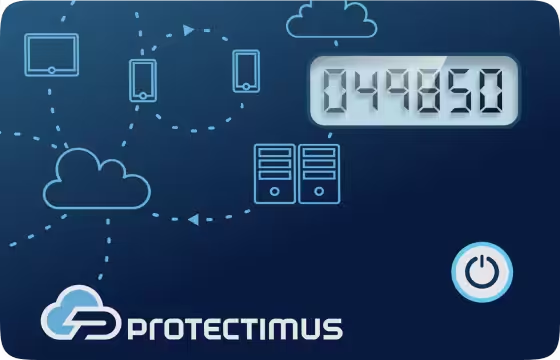
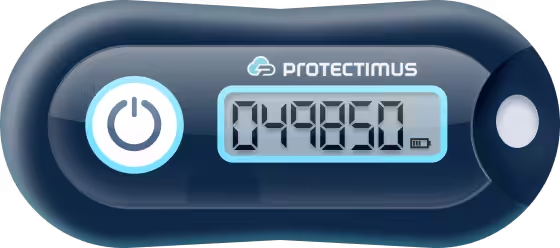
Hardware token (key fob) | Industrial, healthcare, and no-smartphone environments | No | |
Hardware token (card) | Employees who already carry access cards or ID badges | No |
Note: Automatic enrollment currently supports Protectimus SMART OTP, SMS OTP, and Email OTP. Push notifications, hardware tokens, and OTP delivery via chatbots in messaging apps can be assigned manually by administrators.
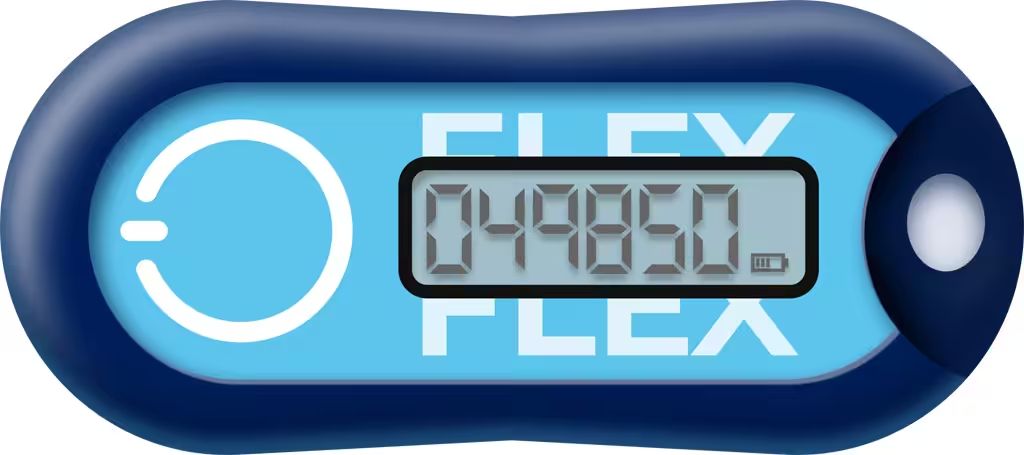
Hardware TOTP tokens are particularly relevant for RDP in industrial or healthcare settings where smartphones are prohibited. The Protectimus Slim NFC and Protectimus FLEX can be reprogrammed over NFC when needed, allowing the same token to be reused instead of being replaced.
RDP MFA Deployment Scenarios
Scenario 1: Standalone Windows Server
Install the Protectimus Winlogon Agent on the Windows server, connect it to the Protectimus service or on-premises platform, and configure users and authentication methods. All RDP sessions — and local console logins — to that server now require a second factor. Typical for branch offices, jump hosts, or small business servers.
Scenario 2: Multi-Server Environment
In environments with multiple Windows servers, install the Protectimus Winlogon Agent on each server that accepts user logins. All servers can be connected to the same Protectimus Resource, allowing administrators to manage MFA policies, users, and authentication methods centrally while protecting every RDP endpoint.
Scenario 3: Active Directory Deployment via GPO
For larger environments, Protectimus supports centralized deployment through Group Policy. Administrators can install the component on a Domain Controller and create a GPO for automatic deployment across selected servers and workstations. This significantly reduces rollout effort and ensures consistent MFA protection throughout the Windows environment.
Note: Protectimus Winlogon protects Windows logons and RDP access on the systems where the component is installed. Organizations seeking MFA protection across all Active Directory–integrated services may also consider MFA for Active Directory via Protectimus DSPA, which enforces dynamic one-time passwords at the directory level.
System Requirements & Compatibility
Supported Windows OS (RDP host)
OS | Status |
|---|---|
Windows Server 2022 | Fully supported |
Windows Server 2019 | Fully supported |
Windows Server 2016 | Fully supported |
Windows Server 2012 / 2012 R2 | Fully supported |
Windows 10 / 11 | Fully supported |
Windows 8 / 8.1 | Fully supported |
AD-joined and standalone workgroup servers are both supported. No Active Directory schema changes or custom directory extensions are required.
Protectimus server requirements (on-premises)
Component | Minimum |
|---|---|
CPU | 2 vCPU |
RAM | 8 GB |
Storage | 20 GB |
OS | Linux, Windows, FreeBSD |
Java | JDK 8+ |
Database | PostgreSQL 10+ |
For cloud deployment, no server infrastructure is required beyond the Winlogon Agent on the RDP host.
Step-by-Step: How to Add MFA to RDP in 4 Steps
Step 1: Deploy the Protectimus Authentication Server
Choose your deployment model:
Cloud: Register at service.protectimus.com. No server infrastructure is required. The free plan includes up to 10 users, and new accounts receive a $25 testing credit for evaluating paid authentication methods and filters.
On-Premises: Install the Protectimus On-Premise Platform on your own infrastructure. Configure the database, create an administrator account, and verify access to the management console.
After deployment, create a Resource that will be used to manage users, tokens, and Winlogon access policies.
Step 2: Configure Winlogon Access Policies
Open the Resource settings and navigate to the Winlogon tab.
Configure the required access policies, including:
- Enable access for local Windows logons and/or RDP sessions.
- Enable two-factor authentication.
- Configure automatic user registration.
- Configure automatic token enrollment.
- Select the authentication methods available for automatic enrollment (Protectimus SMART OTP, SMS OTP, or Email OTP).
- Configure trusted IP addresses, if required.
- Choose whether MFA should be required for all users or only selected accounts.
For most deployments, Protectimus recommends enabling automatic registration of users and tokens.
Step 3: Install the Protectimus Winlogon Agent
Download the latest Protectimus Winlogon installer and run it on the Windows server you want to protect.
During installation, provide:
- API URL
- Account login
- API key
- Resource ID
You can also configure:
- MFA policies for local and RDP logons
- Offline access settings
- Backup code generation
- RDP-only MFA enforcement
In Active Directory environments, administrators can additionally deploy the component through Group Policy (GPO) or perform remote installation from a Domain Controller.
Step 4: Enroll Users and Test Authentication
If automatic registration is enabled, users will be prompted to enroll an authentication method during their first successful login.
Organizations using hardware OTP tokens, push notification or chatbot-based authentication can create users and assign tokens manually.
After enrollment, verify both local Windows logons and Remote Desktop logons to confirm that MFA policies are applied correctly. Before ending the current administrator session, test authentication using a secondary account to avoid accidental lockout caused by configuration errors.
For detailed screenshots and deployment examples, see the full step-by-step RDP integration guide.
Advanced Configuration Options
Option | What it does |
|---|---|
Separate Local and RDP Policies | Configure different access rules for local Windows logons and Remote Desktop sessions. For example, require MFA only for RDP access while allowing standard local logons. |
Automatic User Registration | Automatically create user accounts in Protectimus when users log in for the first time. |
Automatic Token Enrollment | Prompt users to enroll a supported authentication method during their first login. |
Trusted IP Addresses | Allow users to log in without an OTP when connecting from specified trusted IP addresses. |
GPO Deployment | Deploy, update, and remove the Winlogon component centrally through Active Directory Group Policy. |
Remote Installation | Install the Winlogon component directly on selected domain computers from a Domain Controller without waiting for GPO processing. |
Installation Protection | Prevent unauthorized removal of the Winlogon component from managed workstations. |
Compliance & Security Standards
MFA for RDP maps directly to authentication requirements across the major frameworks:
NIST SP 800-63B — Assurance Level 2+ requires MFA for remote access. TOTP-based authenticators satisfy the “something you have” requirement. See NIST SP 800-63B.
HIPAA Security Rule — Requires technical controls against unauthorized ePHI access over a network. RDP to healthcare servers transmits ePHI; MFA is the primary control. See HHS guidance.
PCI DSS v4.0 — Requirement 8.4.2 mandates MFA for all non-console administrative access into the cardholder data environment. RDP is explicitly non-console.
SOC 2 (Type II) — CC6.1 (logical access controls). Auditors flag RDP without MFA. A documented deployment with event logging typically satisfies the evidence requirement.
ISO 27001:2022 — Annex A control 8.5 requires strong authentication for privileged and remote access.
NIS2 Directive (EU) — Article 21 mandates MFA for essential and important entities. RDP to production systems is clearly in scope.
Customer Stories & Use Cases
Financial services: post-incident hardening across 200+ servers
A regional financial services firm experienced a credential stuffing incident: an attacker authenticated to a Windows Server via RDP using credentials from an unrelated SaaS breach and moved laterally for 40 minutes before a SIEM alert fired. The CISO needed deployment across 200+ servers in under two weeks without AD schema changes — a schema modification would have taken months through their change control process. The team pushed the Winlogon Agent via Group Policy MSI. Users enrolled their authentication methods during their first successful Windows or RDP login. Within 10 days, every RDP-accessible server required a second factor; 15 senior administrators on the trading floor received hardware tokens instead of smartphone apps.
Healthcare: HIPAA audit readiness
A multi-site healthcare provider had one gap in their HIPAA Security Rule review: RDP access to EMR servers without MFA. Their legal team required all authentication data to remain on-premises, since authentication logs would contain sensitive user access information and timestamps related to systems processing ePHI. The on-premises Protectimus platform was operational in under three hours. The external auditor accepted the event log export as part of the organization’s evidence for HIPAA audit controls under 45 CFR § 164.312(b).
Manufacturing: hardware token rollout, no smartphones
An automotive parts manufacturer needed MFA for production floor Windows servers where operators don’t carry smartphones and cell signal is unreliable. The company standardized on Protectimus Slim NFC tokens — card format carried alongside access badges. Tokens were pre-provisioned by the administrator; no end-user enrollment step required. Hardware TOTP tokens continue generating one-time passwords without internet or cellular connectivity, making them well suited for environments where smartphones are prohibited or mobile coverage is unreliable.
FAQ
Does Protectimus MFA work with NLA (Network Level Authentication)?
Yes, and NLA should remain enabled. The Protectimus Winlogon Agent integrates at the Windows Credential Provider layer, which is compatible with NLA. Users enter their Windows credentials and OTP as part of the authentication flow before the remote desktop session opens.
What happens if the Protectimus server is unavailable?
If the Protectimus service or on-premises platform is temporarily unavailable, users cannot complete MFA using standard authentication methods until connectivity is restored.
For emergency scenarios, Protectimus supports one-time backup codes that can be used instead of an OTP to access protected Windows systems. Backup codes are generated during Winlogon installation, and a new backup code is automatically issued each time the previous one is used. Backup codes should be stored securely as part of the organization’s business continuity plan.
Can I use hardware tokens instead of a smartphone?
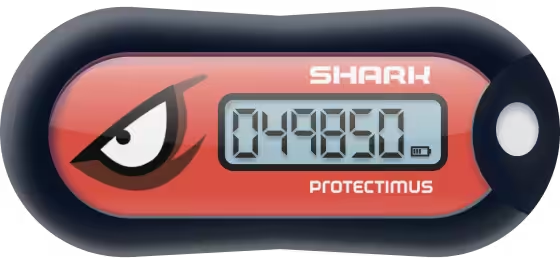
Yes. Protectimus supports all OATH-TOTP hardware tokens, including Protectimus TWO, FLEX, SHARK, and Slim NFC. Hardware tokens work in environments where smartphones are prohibited and operate independently of network connectivity.
How long does it take to deploy across 50 servers?
A scripted or Group Policy deployment across 50 servers typically completes within a single work day. The installer supports silent installation with command-line parameters. User enrollment runs in parallel with the rollout, with users enrolling their authentication methods during their first successful Windows or RDP login.
Is there an on-premises option for data residency requirements?
Yes. The full Protectimus platform can be deployed on your own infrastructure, including Linux, Windows, and FreeBSD environments. All authentication data, logs, and user records remain within your network perimeter while providing the same feature set as the cloud service.
What is the difference between MFA for RDP and Winlogon?
The Protectimus Winlogon component protects both local Windows logons and Remote Desktop sessions using a single agent. The /winlogon/ page covers all supported Windows authentication scenarios. This page focuses specifically on Remote Desktop access, including the RDP threat model, Network Level Authentication (NLA) compatibility, deployment scenarios, and best practices for securing RDP environments. For the full installation guide, see MFA for Windows Logon and RDP.
Get Started with RDP MFA Today
The Protectimus cloud service includes a free plan for up to 10 users, allowing organizations to validate a complete deployment on a representative server before a broader rollout. New accounts also receive a $25 testing credit for evaluating additional authentication methods. The on-premises MFA platform is available for organizations with data residency requirements.
If your scope extends beyond RDP — VPN, Windows local logon, ADFS — the same platform covers all of these from a single admin console. MFA for Active Directory via the DSPA component and RADIUS MFA for VPN are available as part of the broader Protectimus ecosystem.
Conclusion
RDP remains the most direct path from the internet into your Windows infrastructure. A stolen password is all an attacker needs to walk through it. A second factor — a 30-second TOTP code generated by a mobile app or hardware token — makes that credential worthless on its own.
The Protectimus Winlogon Agent adds MFA at the Windows Credential Provider layer, protecting both local Windows logons and Remote Desktop sessions while remaining fully compatible with Network Level Authentication (NLA). The solution can be deployed in hours and scaled across large Windows environments using centralized deployment tools.
For the complete installation walkthrough, see the full step-by-step RDP integration guide →