How to Set Up MFA for Palo Alto GlobalProtect VPN
Last updated: October 31, 2026
You can add MFA to Palo Alto GlobalProtect VPN with Protectimus via RADIUS. The firewall sends GlobalProtect logins to the Protectimus RADIUS Server through a RADIUS server profile, and after the password users confirm sign-in with a one-time password from a hardware token, an authenticator app, or a messenger chatbot. Protectimus runs in the cloud or on-premise.
This guide shows how to enable two-factor authentication (2FA / MFA) for Palo Alto Networks VPN using the Protectimus Cloud 2FA Service or On-Premise 2FA Platform.
Protectimus integrates with Palo Alto GlobalProtect VPN via RADIUS authentication protocol to add two-factor authentication (2FA) to VPN logins.
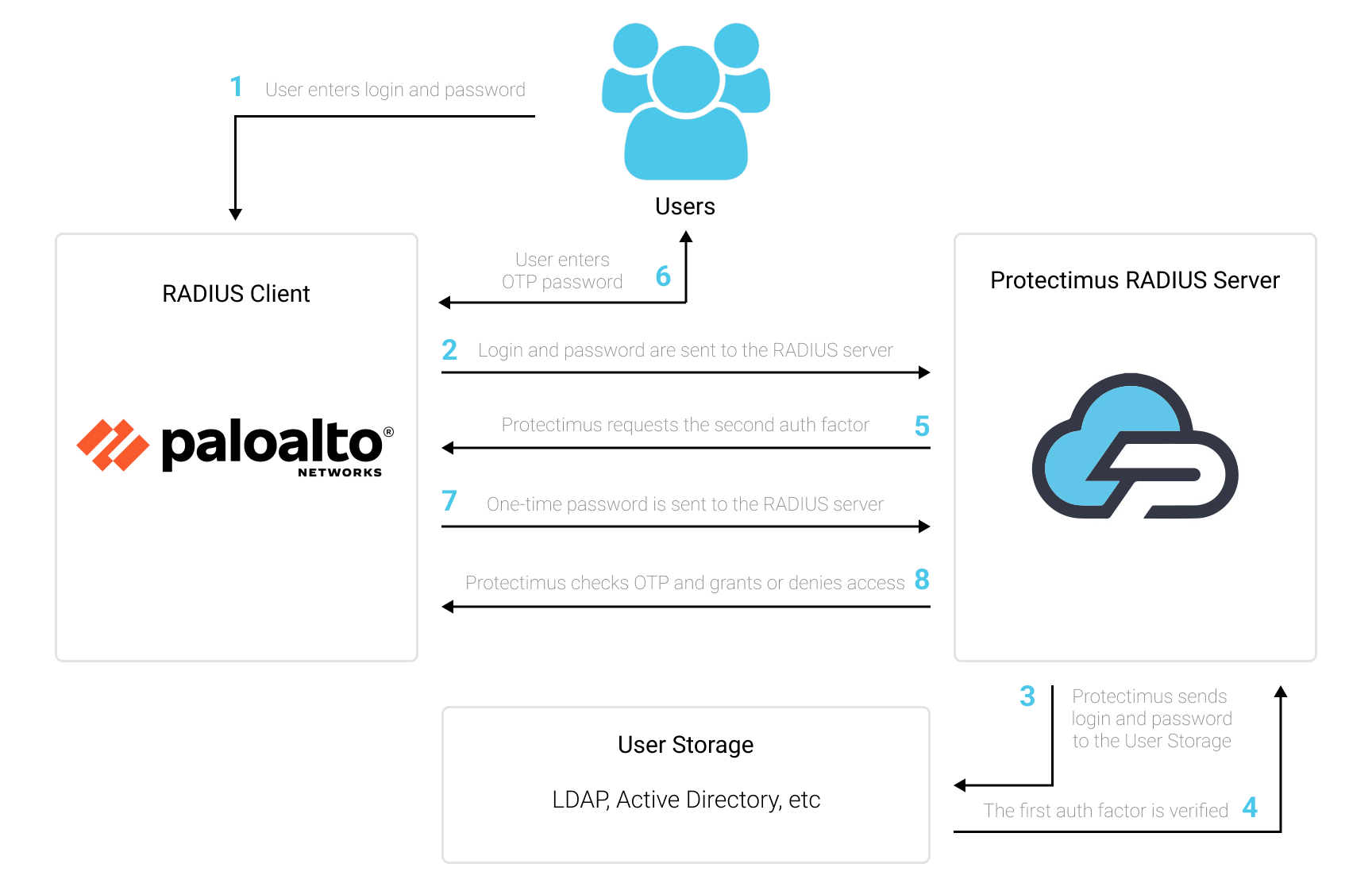
In this scenario, the Protectimus two-factor authentication solution for Palo Alto GlobalProtect VPN 2FA performs as a RADIUS server, and the Palo Alto Networks VPN takes the role of a RADIUS client. You will find the scheme of work of the Protectimus solution for Palo Alto Networks VPN two-factor authentication below.
Requirements and Supported Versions
| Component |
Requirement |
| Palo Alto Networks |
Firewall with a GlobalProtect portal and/or gateway and RADIUS authentication support |
| Authentication protocol |
PAP; on PAN-OS 7.x, set it in the CLI with set authentication radius-auth-type pap |
| RADIUS timeout |
At least 30 seconds in the RADIUS server profile |
| Protectimus |
Protectimus Cloud Service or Protectimus On-Premise Platform |
| RADIUS component |
Protectimus RADIUS Server installed in your network; with the On-Premise Platform for Windows, select the RADIUS option during installation |
| RADIUS port |
1812 by default (set in radius.yml) |
| Users and tokens |
Added to a Protectimus resource manually or through the Users’ Self-Service Portal |
Why Use Protectimus MFA for Palo Alto GlobalProtect
- Works through RADIUS. PAN-OS uses a standard RADIUS server profile, so RADIUS authentication with Protectimus needs no change to the GlobalProtect app.
- Portal, gateway, or both. One authentication profile can be assigned to the GlobalProtect portal, the gateway, or both, and limited to all users or to a specific group.
- Cloud or on-premise. Use the Protectimus Cloud Service or keep authentication data on your own servers with the On-Premise Platform.
- Hardware and software tokens. Hardware OTP tokens or an authenticator app on a smartphone, added manually or by users themselves in the Self-Service Portal.
- One MFA layer for mixed environments. The same Protectimus resource and tokens can protect other VPN gateways and systems; see MFA for VPN for the wider picture.
How Two-Factor Authentication (2FA) Works for Palo Alto Networks VPN
Two-factor authentication (2FA), also known as multi-factor authentication (MFA), is a must-have security measure for Palo Alto GlobalProtect VPN. 2FA will protect Palo Alto GlobalProtect VPN logins from such threats as phishing, brute force, data spoofing, social engineering, keyloggers, man-in-the-middle attacks, etc.
And this is how two-factor authentication for Palo Alto GlobalProtect VPN works:
-
- When a user initiates login to the Palo Alto GlobalProtect VPN protected with two-factor authentication, first of all, they will enter the first authentication factor – their standard password and login (something they know).
- Then they will be asked to enter a second authentication factor – a one-time passcode from the two-factor authentication token (a 2FA token is something the user has – usually, it is a smartphone or a physical OTP token looking like a keyfob).
This way, to get access to the Palo Alto GlobalProtect VPN account protected with two-factor authentication, the fraudster has to get access to two authentication factors that differ in their nature. That is quite a challenging task. Moreover, a time-based one-time password remains active only for 30 seconds, which makes hacking way more complecated and almost impossible.
How to Enable Two-Factor Authentication (2FA) for Palo Alto Networks VPN
You can set up Palo Alto Networks VPN two-factor authentication (2FA) with Protectimus using the RADIUS protocol:
- Get registered with Protectimus SAAS Service or install the On-Premise 2FA Platform and configure basic settings.
- Install and configure Protectimus RADIUS Server.
- Configure Palo Alto Networks VPN authentication policies.
Step 1: Get Registered and Configure Basic Protectimus Settings
Choose your deployment option and complete the basic setup:
Protectimus Cloud Service
- Register with the Protectimus Cloud Service and activate API.
- Add a Resource.
- Add Users.
- Add Tokens manually or activate the Users’ Self-Service Portal.
- Assign Tokens to Users.
- Assign Users and Tokens to the Resource.
Protectimus On-Premise Platform
- Install the Protectimus On-Premise Platform. If you install the Protectimus Platform on Windows, select the RADIUS option during installation.
- Add a Resource.
- Add Users.
- Add Tokens manually or activate the Users’ Self Service Portal.
- Assign Tokens to Users.
- Assign Tokens with Users to the Resource.
Step 2: Install and Configure Protectimus RADIUS Server
Detailed instructions for installing and configuring the Protectimus RADIUS Server for Palo Alto Global Protect VPN 2FA using RADIUS are available in our
Protectimus RADIUS Server Installation Guide for Palo Alto Networks VPN 2FA.
Step 3: Configure Palo Alto Networks RADIUS Server Profile
- Log in to the Palo Alto Networks administrative interface.
- On the Device tab, navigate to Server Profiles, then RADIUS.
- Click the Add button to add a new RADIUS server profile. You will see the following window:
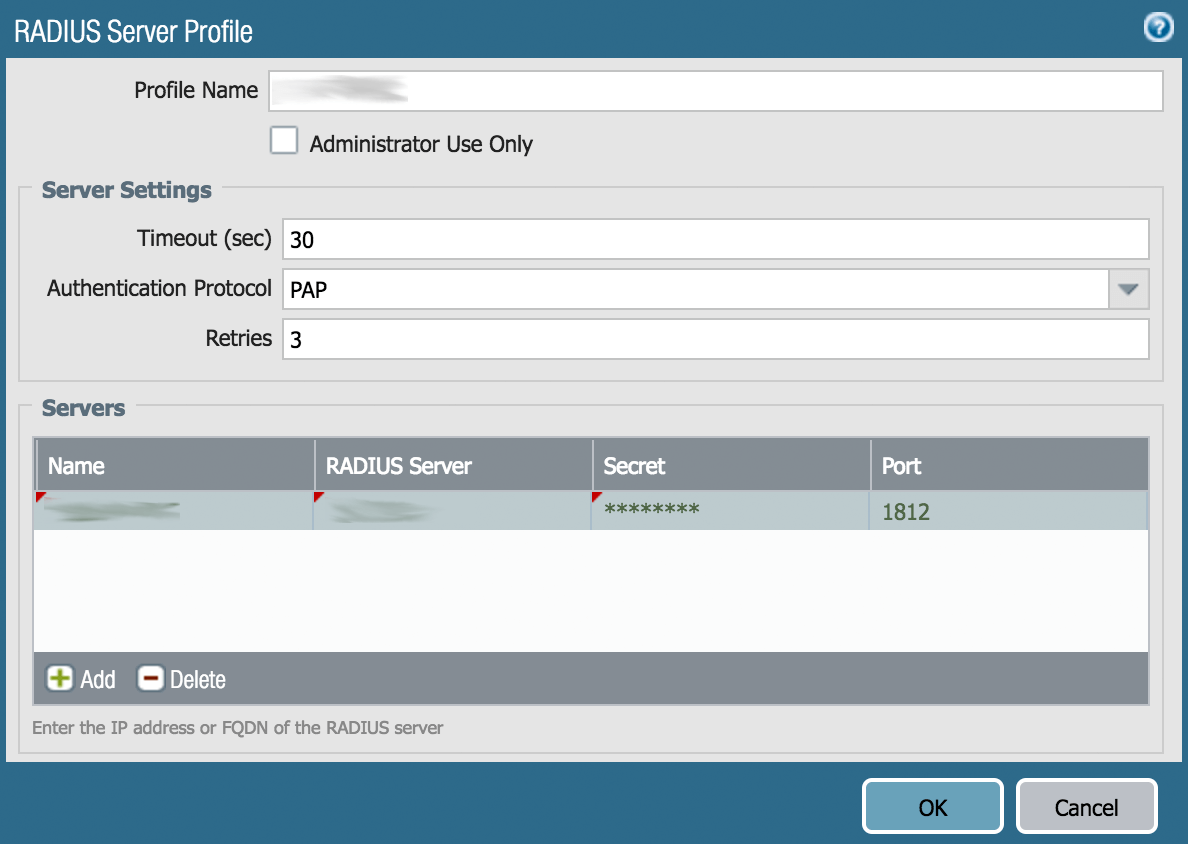
- In the Profile Name field come up with a name for your RADIUS server, enter Protectimus RADIUS or any other name you wish.
- Increase the Timeout to at least 30 seconds.
- Change the Authentication Protocol to PAP.
PLEASE NOTE!
PAN-OS 7.x users must set the protocol in the CLI with this command:
set authentication radius-auth-type pap
- Click on Servers –> Add button, to add a RADIUS server. After this, enter the below information:
| Server |
Type any name for your RADIUS server – enter Protectimus RADIUS or any other name you wish. |
| RADIUS Server |
IP of server where the Protectimus RADIUS Server component is installed. |
| Secret |
Indicate the shared secret you created in the Protectimus radius.yml file (radius.secret property) when configuring Protectimus RADIUS Server |
| Port |
Indicate 1812 (or whichever port you configured in the Protectimus radius.yml file when configuring Protectimus RADIUS Server). |
- Click OK and save the new RADIUS server profile.
Step 4: Create an Authentication Profile in Palo Alto Networks
- Go to the Device tab and navigate to Authentication Profile.
- Click on Add to create a new authentication profile, you will see the following window:
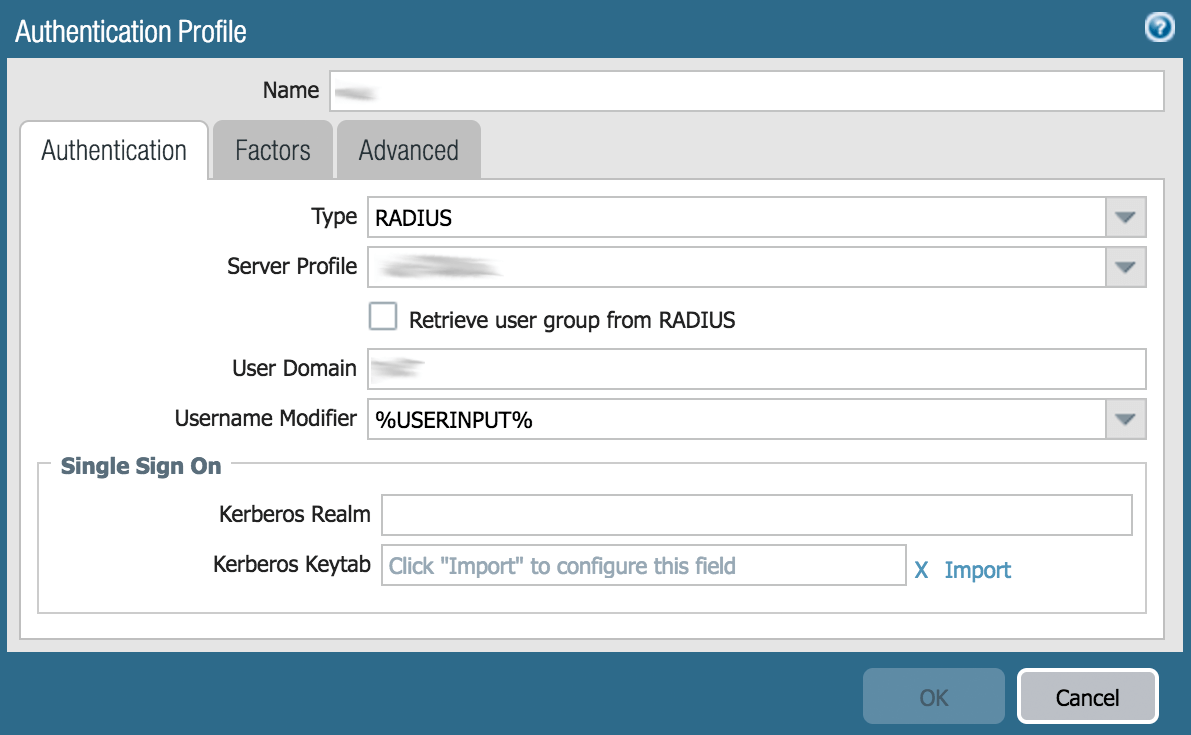
- Enter the following data:
| Name |
Type PROTECTIMUS ot choose any name you wish. |
| Type |
Select RADIUS from the drop-down list |
| Server Profile |
Select Protectimus RADIUS from the drop-down list (or whatever name used to create the RADIUS Server Profile in Step 3.) |
- Keep the rest of the options on the current screen as their defaults.
- Then click the Advanced tab and select the all group or choose a specific group to which this authentication profile will apply.
- Click OK and save the Authentication profile you have created.
Step 5: Assign the Authentication Profile to the GlobalProtect Portal and/or Gateway
You can configure multiple client authentication configurations for the Palo Alto GlobalProtect portal and gateways. For each client authentication configuration, you can specify the Authentication Profile to apply to endpoints of a specific OS.
This step describes how to add the Authentication Profile to the Palo Alto GlobalProtect VPN portal or gateway configuration. For additional details on setting up these components, see the PaloAlto Networks documentation on
GlobalProtect Portals and
GlobalProtect Gateways.
- Go to Network –> GlobalProtect –> Gateways or Portals.
- Click on your configured GlobalProtect Gateway to bring up the properties window.
- In the newly-opened window, select the Authentication tab.
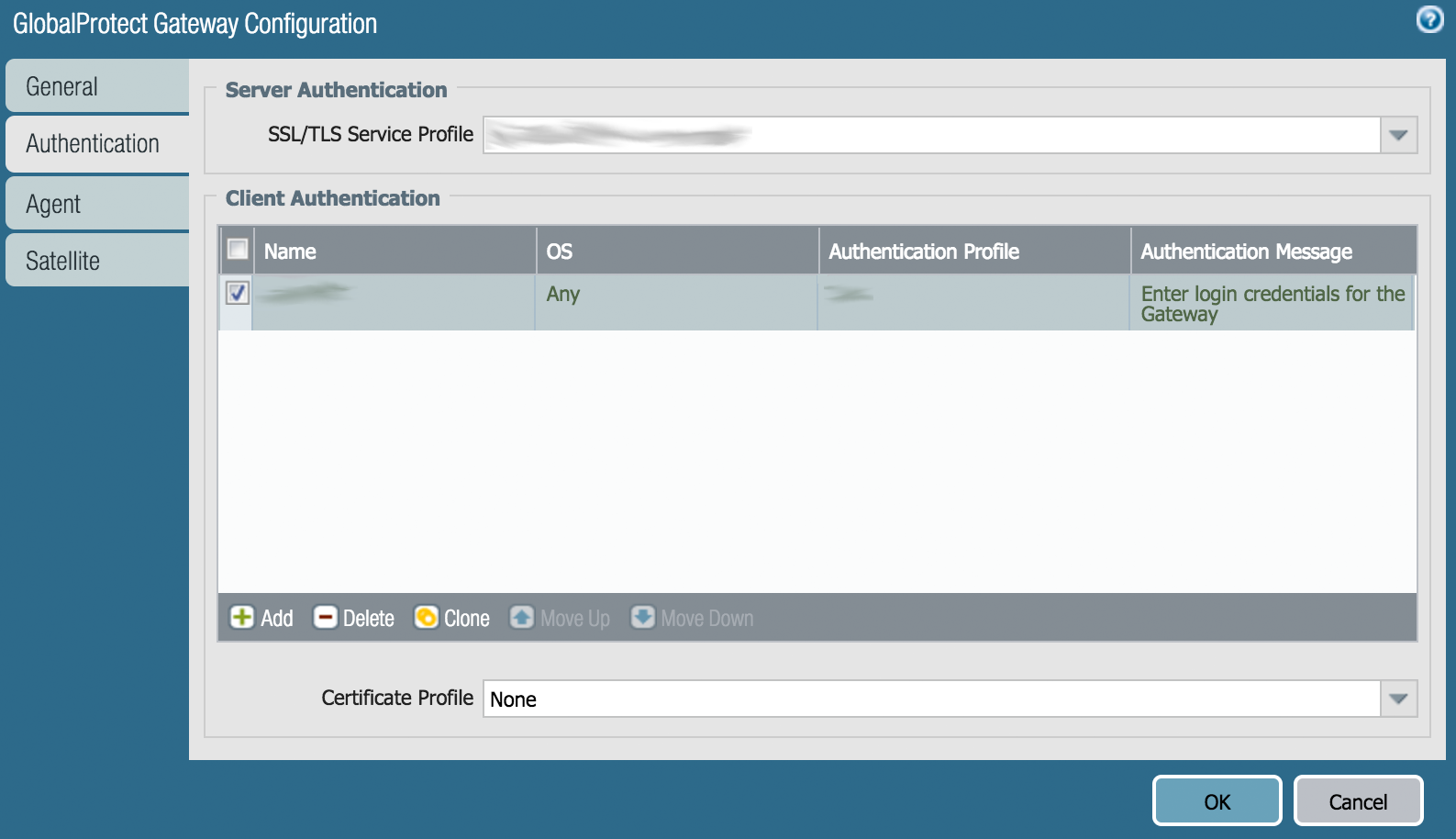
- Select an SSL/TLS Service Profile or Add a new one.
- Depending on your configuration, click the current entry under Client Authentication to modify it or create a new one by clicking the Add button.
- Fill in the Client Authentication form with the following information.
| Name |
Enter any descriptive name you wish. |
| OS |
Any |
| Authentication Profile |
Select the Authentication Profile you have created in Step 4. |
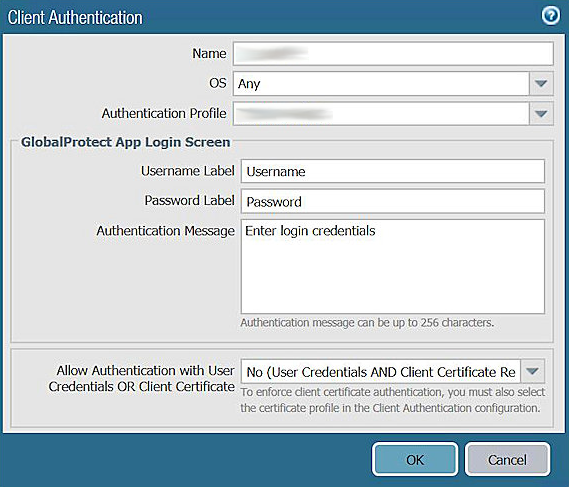
- Click OK to save the configuration.
Integration of two-factor authentication (2FA/MFA) for your Palo Alto Networks VPN is now complete.
If you have other questions, contact
Protectimus customer support service.
FAQ
Does Palo Alto GlobalProtect support MFA natively, or do I need a third-party solution?
PAN-OS can send GlobalProtect authentication to an external RADIUS server, and that is how third-party MFA such as Protectimus is added. A separate MFA server makes sense when you want the same users, tokens, and policies for the VPN and for other systems.
Can I use hardware tokens for GlobalProtect VPN login?
Yes. Users can sign in with a code from a hardware OTP token instead of a smartphone app. The token is assigned to the user in Protectimus, and the GlobalProtect side of the setup stays the same.
Why does GlobalProtect need PAP for RADIUS authentication with Protectimus?
This integration is configured with PAP as the authentication protocol in the RADIUS server profile. PAP passes the user’s credentials in a form the Protectimus RADIUS Server can check. On PAN-OS 7.x, the protocol is set from the CLI with the command
set authentication radius-auth-type pap.
Can I require MFA only on the GlobalProtect portal or only on the gateway?
Yes. In the last step of the setup, the authentication profile is assigned to the GlobalProtect portal, the gateway, or both. Open Network > GlobalProtect > Portals or Gateways, select the Authentication tab, and choose the authentication profile in the Client Authentication settings.
What happens if the MFA server is unavailable?
The firewall waits for a response from the Protectimus RADIUS Server for the timeout set in the RADIUS server profile and then rejects the login. To keep VPN access available, deploy redundant Protectimus RADIUS Server instances and add them to the server profile; with the On-Premise Platform, the platform itself can run as a multi-node cluster.
Planning MFA for more than one gateway?
Compare MFA options for VPN or
start a free trial of Protectimus.